Cloud CRM 2026: A Practical Guide for Modern Businesses
Cloud CRM has become the backbone of modern customer management. Instead of storing data on local servers, businesses now use cloud-based platforms to track sales, support conversations, and customer relationships in real time.

Most businesses don’t fail because they lack ambition.
They fail because they lose track of people. Conversations get scattered. Follow-ups are missed. Customers feel ignored.That’s where cloud CRM steps in. Not as a flashy tool. Not as a trend. But as the system that quietly keeps relationships alive, organized, and growing—day after day.
What is cloud CRM?
It’s customer relationship management software hosted online, allowing teams to access data from anywhere.
Is cloud CRM worth using?
Yes, especially for growing businesses that need flexibility, automation, and real-time updates.
How does cloud CRM work?
It stores customer data on cloud servers and syncs it across devices, teams, and platforms.
Understanding CRM Software and Customer Relationship Management
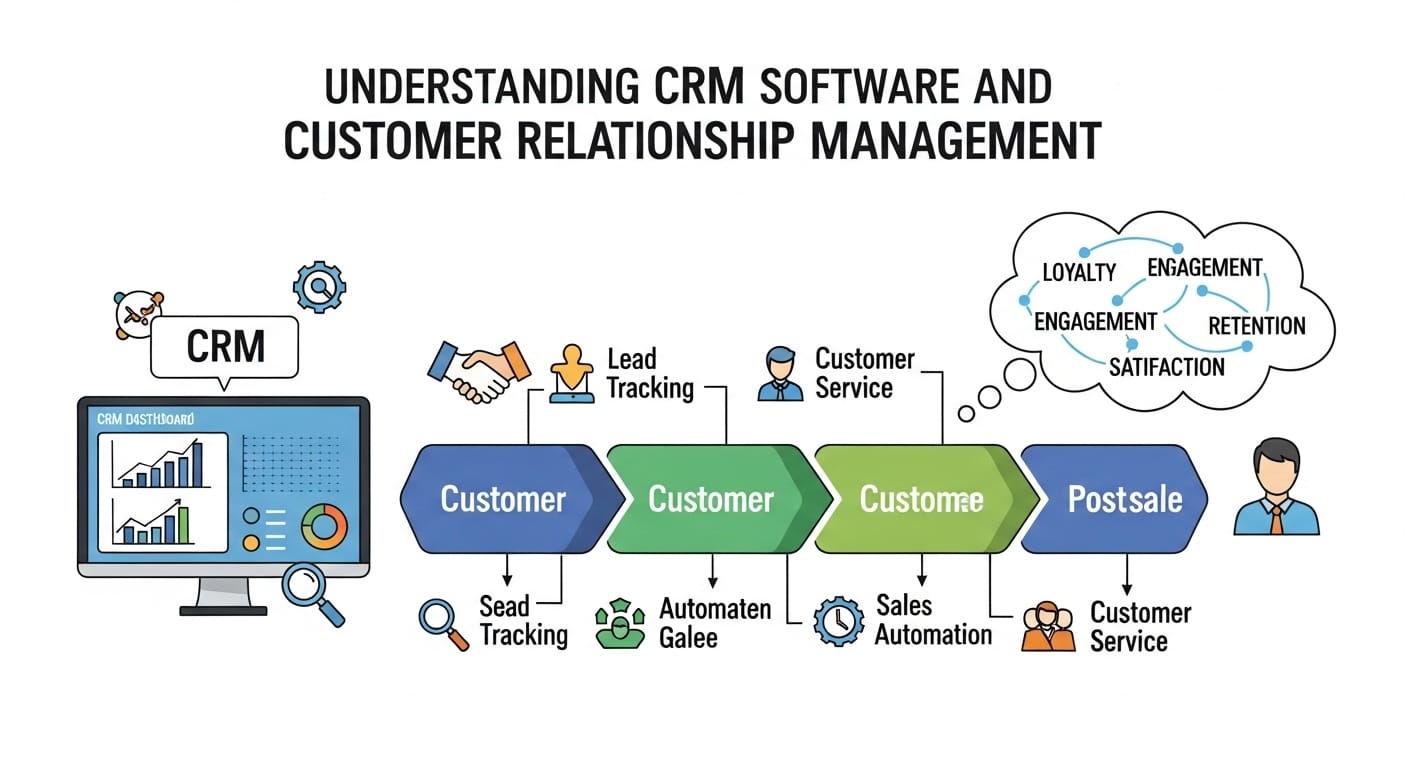
At its core, CRM software exists for one reason: memory. Not human memory, which fades, but digital memory that never forgets. Every call. Every message. Every purchase. Every complaint. All stored, organized, and accessible when needed. This digital record allows businesses to understand customers beyond surface-level interactions and build stronger, more consistent relationships over time.
To see how this works in real business environments, explore these detailed CRM software examples that demonstrate how modern platforms capture, manage, and use customer data effectively. With the right system in place, companies no longer rely on guesswork. Instead, they operate with clarity, continuity, and confidence powered by accurate customer insights.
Customer relationship management isn’t about selling more aggressively. It’s about understanding better. When did someone last contact you? What did they ask? What frustrated them? What made them happy? A proper CRM system meaning starts right here.
Before cloud systems, most companies relied on spreadsheets, emails, notebooks, and half-remembered details. Things slipped through cracks. Deals died quietly. Customers drifted away.Cloud-based CRMs changed that rhythm. Suddenly, everything lived in one place. Accessible. Searchable. Shareable. Teams stopped guessing and started knowing. That shift alone transformed how businesses interact with people.
What Is Cloud-Based CRM Software and How It Works
Cloud-based CRM software lives on remote servers instead of local computers. That sounds technical. It isn’t. It simply means you log in and everything is there. No installations. No manual updates. No dependency on office computers.When someone updates a contact, everyone sees it. When sales adds notes, support reads them. When marketing tracks behavior, managers analyze it. The system stays synchronized in real time.
This setup fits the reality of modern work—remote teams, hybrid offices, freelancers, agencies, and contractors working across different time zones and continents. Everyone stays connected, even when physically separated. That is why cloud CRM is no longer optional. It matches how people actually work today: flexible, distributed, and constantly moving.
With real-time access to data and conversations, teams can collaborate seamlessly from anywhere. Tools that support business chat platforms and customer communication systems further strengthen this ecosystem by ensuring messages, updates, and customer interactions remain organized and accessible. When CRM and modern communication tools work together, businesses gain the agility needed to operate efficiently in a global, digital-first environment.
CRM System Meaning in Real Business Life
Many guides explain what CRM means in theory. Dashboards. Pipelines. Metrics. Reports. All true. But incomplete.
In real life, CRM management meaning is about emotional continuity. When a customer feels recognized. When they don’t need to repeat themselves. When support remembers their history.
It’s the difference between “Please explain again” and “Yes, I remember your issue.”
That difference builds loyalty.A cloud CRM system becomes the shared memory of your company. New staff learns faster. Old staff hands over smoothly. No knowledge disappears when someone leaves.That stability matters more than most people realize.
How Cloud CRM Connects Sales, Support, and Marketing
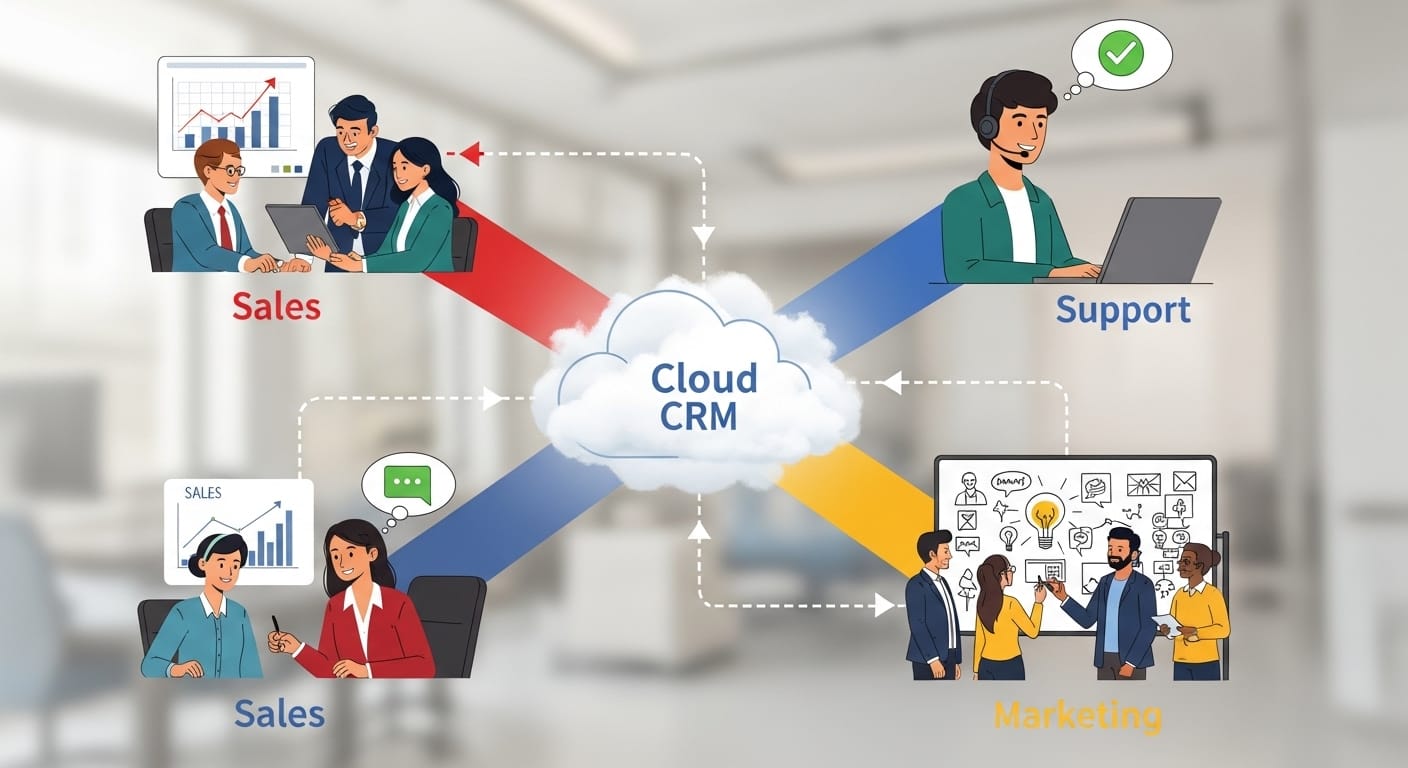
Sales teams chase opportunities. Support teams fix problems. Marketing builds awareness. Traditionally, they worked in silos.
Cloud CRM dissolves those walls.
Sales sees support history. Marketing sees buying patterns. Support sees previous campaigns. Everyone works from the same truth.Take Salesforce Salesforce CRM as an example. It integrates customer journeys from first click to long-term loyalty. Every department sees the same story, from different angles.
This alignment reduces friction. No more blaming departments. No more missing context. Just clearer cooperation.And clearer cooperation means better service.
Cloud CRM and Modern Communication: The Kuikwit Connection
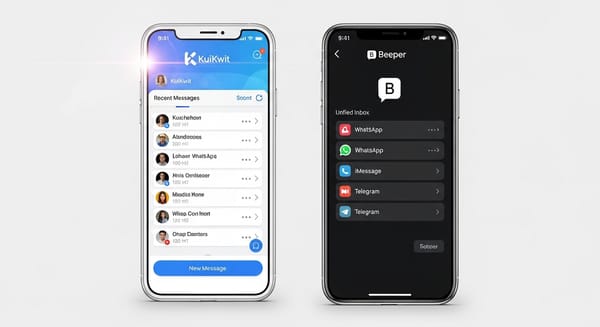
Here’s where tools like Kuikwit.com fit in naturally.Kuikwit centralizes messages from WhatsApp, Facebook, Instagram, and more into one dashboard. Cloud CRMs handle customer records. Kuikwit handles conversations.
Together, they form a complete loop.
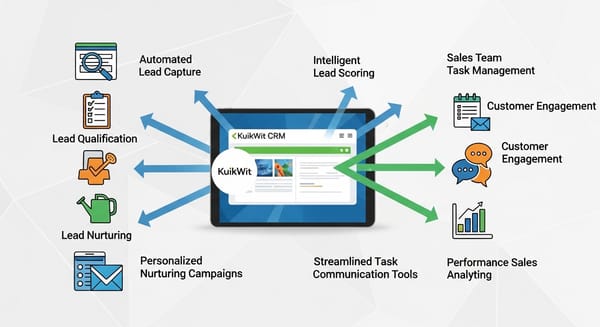
Messages flow into Kuikwit. Data flows into CRM. Agents see full history. AI-powered replies speed things up. Analytics reveal patterns.Instead of juggling apps, teams work from one environment. That saves time. Reduces errors. Improves consistency.In practice, it means customers feel heard faster. And businesses respond smarter.
Benefits of Cloud-Based CRM for Growing Companies
The biggest benefit is clarity. No more fragmented systems. No more scattered files. Everything connects.
Second is scalability. You start small. Add users later. Upgrade when ready. The system grows with you.
Third is reliability. Cloud providers handle backups, security, uptime. You focus on business.
Fourth is mobility. Access data from laptops, phones, tablets. Whether in office or airport.
Finally, automation. Follow-ups. Reminders. Reports. Lead scoring. Repetitive tasks fade into the background.
This isn’t about working harder. It’s about working lighter.
Real-Life Examples of Cloud CRM in Action
A consulting firm used spreadsheets for years. Lost leads constantly. After adopting cloud CRM, conversion improved by 40% within a year. Not magic. Just organization.
An online retailer integrated CRM with Kuikwit. Support response times dropped by half. Complaints turned into compliments.
A contractor company implemented contractor management services login through CRM portals. Clients tracked projects. Payments sped up. Trust increased.A startup used Microsoft Dynamics for forecasting. Growth stabilized. Investors felt confident.These stories repeat everywhere. Systems create structure. Structure supports growth.
Common Mistakes When Using CRM Systems
Many companies buy CRM and expect miracles. Then abandon it.
First mistake: no training. Tools unused are tools wasted.
Second: overcomplication. Too many fields. Too many workflows. People resist complexity.
Third: poor data hygiene. Old records. Duplicates. Inaccurate entries. Garbage in, garbage out.
Fourth: ignoring integration. CRM isolated from email, chat, accounting becomes limited.
Fifth: lack of leadership support. If managers don’t use it, nobody will.
Technology needs culture. Without that, it fails quietly.
Comparing Cloud CRM With Traditional On-Premise Systems
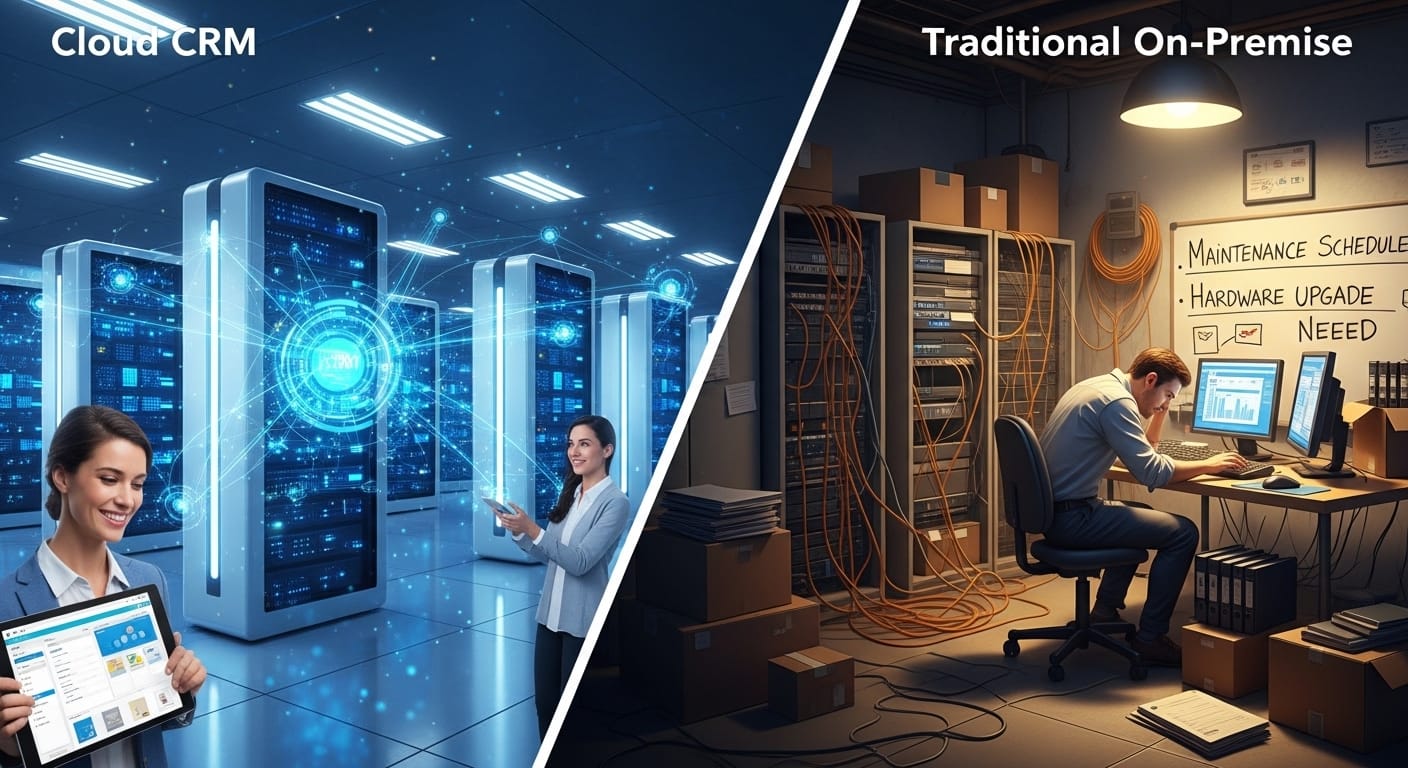
Traditional CRM lives on local servers. You maintain hardware. You manage updates. You handle security.
Cloud CRM removes that burden.On-premise offers control. Cloud offers agility.
On-premise suits heavily regulated industries sometimes. Cloud suits most modern businesses.Cost-wise, cloud uses subscriptions. On-premise demands upfront investment.Feature-wise, cloud evolves faster. Updates arrive automatically. New tools appear regularly.
That’s why most new CRM deployments choose cloud by default.
Cloud CRM and ERP in Cloud Computing
Today, ERP and cloud computing intersect closely with CRM systems, creating powerful, unified business platforms. ERP manages core operations such as inventory, finance, and manufacturing, while CRM focuses on customer relationships. Together, they form the foundation of modern business intelligence.
When ERP systems integrate with cloud-based CRM, companies gain full visibility into the entire business cycle—from lead generation and sales to invoicing and delivery. This connection reduces operational delays, improves forecasting accuracy, and strengthens accountability across departments. By leveraging advanced technologies such as Intelligen AI-powered business intelligence, organizations can further enhance data-driven decision-making and operational efficiency. Modern enterprises no longer treat these systems as separate tools. Instead, they connect them into a single, intelligent ecosystem that supports smarter planning, faster execution, and long-term growth. This integration is efficiency in practice.
Agent CRM and Customer-Centric Workflows
Agent CRM platforms are designed specifically for frontline professionals such as support agents, sales representatives, and account managers. Their primary focus is simplicity, speed, and usability. By offering streamlined interfaces, guided workflows, and real-time alerts, these systems help teams stay focused on customers rather than software.
Agents can instantly access complete customer context without digging through multiple screens or databases, eliminating delays and frustration. When integrated with platforms like Kuikwit, agents can manage multi-channel conversations within CRM-linked dashboards, creating a unified communication experience. The result is faster issue resolution, happier employees, and stronger customer retention. As the technology fades into the background, high-quality service takes center stage.
Understanding Microsoft Dynamics and Enterprise CRM
Microsoft Dynamics is Microsoft’s enterprise-level CRM and ERP ecosystem designed to work seamlessly within its broader digital environment. It integrates deeply with tools such as Office, Outlook, Teams, and Azure, making it feel natural for businesses already operating in the Microsoft ecosystem.
Documents sync automatically, emails link directly to customer records, and reports update in real time. This level of integration helps teams work more efficiently and reduces manual effort. Large organizations value its enterprise-grade connectivity, while smaller businesses appreciate its scalability. Ultimately, it is not about company size but about system compatibility. Every CRM platform serves a different workflow rhythm, and Microsoft Dynamics is built for organizations that thrive within Microsoft’s digital framework.
Cloud CRM vs Traditional CRM
| Feature | Cloud CRM | Traditional CRM |
|---|---|---|
| Setup | Quick | Complex |
| Maintenance | Provider | In-house |
| Scalability | Easy | Limited |
| Accessibility | Anywhere | Office-based |
| Updates | Automatic | Manual |
| Cost Model | Subscription | Upfront |
This difference shapes long-term strategy.
Security and Data Protection in Cloud CRM

Security concerns are often the first thing businesses worry about when adopting CRM systems. However, modern cloud-based CRM platforms rely on advanced protection measures such as encryption, strict access controls, continuous monitoring, and well-defined compliance frameworks. Standards like GDPR, SOC 2, and ISO certifications are now common across reputable providers.
Multi-factor authentication helps prevent unauthorized access, while detailed activity logs track user behavior and system changes. In many cases, CRM providers invest far more in security infrastructure than most small businesses could manage independently. Still, responsibility remains shared. Strong passwords, clear access rules, and regular audits are essential practices. Security is not just a feature—it is a habit that must be maintained every day.
People First: The Heart Behind CRM Systems
No system can replace empathy. CRM platforms do not build relationships—people do. Technology simply supports memory, organizes context, and removes friction from everyday interactions. When used thoughtfully, it allows teams to focus more on understanding customers rather than managing data.
Strong organizations use insights with care. They listen closely, respond thoughtfully, and adapt based on real human needs. Poorly managed teams, however, hide behind dashboards and reports, relying on numbers instead of connection. The most successful companies find balance by combining analytics with intuition, using both data and emotional intelligence to guide decisions. This harmony is what creates trust, loyalty, and long-term success.
Building Long-Term Strategy With Cloud CRM
Short-term CRM use focuses on pipelines. Long-term use focuses on insight.Over time, patterns emerge. Buying cycles. Seasonal trends. Customer lifetimes.Smart companies study these signals.They refine offers. Improve onboarding. Personalize communication.
CRM becomes a compass.
Not a control panel. A direction finder.
And that’s powerful.
Full FAQ Section
What does cloud CRM mean?
It refers to CRM software hosted online, accessible via internet-connected devices.
Is cloud CRM suitable for small businesses?
Yes. Many platforms offer affordable plans for startups and freelancers.
Can cloud CRM integrate with social media?
Most modern systems integrate with platforms like Facebook, WhatsApp, and tools like Kuikwit.
Is customer data safe in cloud CRM?
Reputable providers use advanced encryption and compliance standards.
Do I need IT staff to manage cloud CRM?
Usually not. Providers handle infrastructure and updates.
How long does CRM setup take?
From a few hours to several weeks, depending on complexity.
Can cloud CRM help with marketing automation?
Yes. Many include email campaigns, segmentation, and analytics.
What industries benefit most from CRM?
Retail, consulting, healthcare, real estate, SaaS, and finance benefit heavily.
Most people don’t fall in love with software.
They fall in love with clarity.When conversations make sense. When data connects. When nothing feels scattered anymore.
That’s what cloud CRM quietly offers.
No drama. No noise.
Just better memory. Better timing. Better relationships.And somehow, over time, that changes everything.