Positive Attitude in Customer Service: Why It Matters Most
Discover the power of a positive attitude in customer service. Learn how empathy, optimism, and calm communication improve customer experience.


I had a weird experience last month. Ordered a jacket online. Wrong size arrived. Annoying, sure, but not the end of the world. I messaged the brand expecting the usual runaround — ticket number, 48 hour wait, copy-paste apology. Instead, the person who replied said something like “ugh, that is so frustrating, I am sorry. Let me fix this right now.” Got a return label in three minutes. New jacket shipped same day. And you know what? I have already bought two more things from them since. Not because the jacket was amazing. Because that one conversation made me feel like they actually gave a damn.
That is what positive attitude in customer service really is. Not some training module your team sits through on day one and immediately forgets. Not a smiley face at the end of a chat. It is something you feel on the receiving end, and it is the single biggest reason people come back to a brand or quietly disappear to a competitor.
And I think most businesses know this on some level. But knowing it and building it into how your team actually operates every day? Those are two very different things. So let me walk through what this looks like when it is working, what kills it, and how to set your team up so the positive stuff happens naturally instead of being something you have to constantly push for.
First Off — What Are We Actually Talking About Here?
When I say “positive attitude in customer service,” I do not mean being peppy. I have talked to plenty of chirpy agents who clearly did not care about my problem. The enthusiasm was there. The help was not. That is not what we are going for.
What I mean is a default setting in how someone approaches a conversation. It sounds like this internally: “This person came to me with a problem. My job is to figure out how to make this better, even if the answer is not exactly what they want to hear.” That is it. That is the whole attitude. Not toxic positivity. Not pretending everything is fine when it is not. Just a genuine orientation toward helping.
And here is the thing that makes it powerful. When someone operates from that mindset, it shows up in every word they type. They phrase things differently. They ask different questions. They follow up when they do not have to. The customer walks away thinking “that person was really helpful” even if the actual outcome was not perfect. I have seen it turn refund requests into repeat purchases. Genuinely. Not in a motivational-poster way. In a real, money-in-the-bank way.
Why Does This Matter So Much? Because Everything Else Is Basically the Same.
Can I be honest with you for a second? Your product is probably not wildly different from what your competitors sell. Sorry. It might be slightly better. It might have a nicer logo. But in the customer’s mind, most options in any given category look roughly the same. What does not look the same is how it feels to interact with each company. That is where differentiation actually lives. Not in features. In feelings.
People do not make spreadsheets to decide where to buy their next pair of shoes or which SaaS tool to renew. They go with the one that felt right. The one where somebody answered their question without making them feel dumb. The one where the refund was not a battle. We like to think purchasing decisions are logical. They are not. They are emotional, and then we find logic to back them up after the fact.
So when your support agent responds to a confused customer with patience instead of irritation? That is not just “good service.” That is your competitive advantage doing its thing. Quietly. In a random Tuesday afternoon chat. No marketing budget required.
What Happens When Attitude Goes Right

Let me paint two versions of the same situation. Customer messages about a refund that is taking longer than expected.
Version A: “Refunds take 7 business days. You will need to wait.”
Version B: “I know waiting on a refund is the worst. Let me pull up your case and see what is going on. If I can push it through faster, I will. Give me a few minutes.”
Same policy. Same refund timeline. Completely different emotional outcome. Version A makes the customer feel like a nuisance. Version B makes them feel like somebody is in their corner. That is the whole game right there. Most of the time, you are not changing what you can do. You are changing how it lands.
Or try this one. Customer says they cannot find an email you sent.
The lazy reply: “We sent it already. Check your spam folder.”
The human reply: “Those emails have a habit of hiding! Let me resend it right now. Check your inbox in about two minutes.”
One of those makes the customer feel blamed. The other makes them smile a little. Guess which one leads to a five-star review down the road?
Okay But How Do You Actually Get a Team to Do This Consistently?
This is the hard part, honestly. Because you cannot just tell people to be positive. That is like telling someone to be funny. It does not work that way. What you can do is create the conditions where positivity is the natural outcome instead of something people have to force.
Empathy needs to be a habit, not a poster on the wall. I tell my team one thing before they respond to any message: take two seconds and imagine you are the person who wrote it. What is their day like? What do they actually need right now? That tiny pause changes everything. It is the difference between responding to a ticket and responding to a person. Once that shift clicks, you start seeing agents write differently without being told to.
Listening is a skill that most people have never been trained on. In chat especially, agents tend to scan messages for keywords so they can fire off a template. That is not listening. Listening means reading the whole message, catching the emotion underneath, and responding to both the problem and the feeling. A customer who says “this is the third time I am reaching out” is not just stating a fact. They are telling you they feel ignored. If your agent misses that and just answers the technical question, you have failed the interaction even if the answer was correct.
Tiny word swaps make a massive difference. This is the easiest win and I am shocked more teams do not drill it. “I can’t do that” becomes “Here is what I can do.” “That is not my department” becomes “Let me get you to someone who can sort this out.” “You need to” becomes “What I would suggest is.” None of these change the actual substance. They change how it feels. And in customer service, how it feels IS the substance.
Composure under fire is trainable. People will be rude to your agents. It happens. Some customers show up already angry and your agent is just the closest target. The worst thing you can do is tell your team to “just stay calm” like that is a button they can press. Instead, give them actual tools. Permission to pause before replying. A buddy system where they can tag someone else in if they are getting heated. Even just acknowledging in team meetings that some conversations are genuinely hard and it is okay to find them draining. That honesty goes further than any “resilience workshop.”
Catch people doing things right. I cannot overstate this one. When an agent turns around a nightmare conversation and the customer ends up saying thank you? Call that out. Share it in the group chat. Mention it in the weekly meeting. People repeat the behavior that gets noticed. If the only time management pays attention is when something goes wrong, your team will operate from fear instead of pride. And fear does not produce warmth.
Make training feel like a conversation, not a lecture. Nobody learns anything from a 90-slide deck about “communication excellence.” Pull up a real chat transcript from last week. Talk about what went well and what could have landed better. Role-play a tricky scenario. Keep it short and keep it frequent. Fifteen minutes every week beats a three-hour session every quarter. People remember things that feel relevant to their actual work, not abstract principles about “customer centricity.”
Your Managers Set the Ceiling on All of This
I need to be direct here. If your team leads and managers are impatient, short-tempered, or only show up when things go wrong, it does not matter how many training sessions you run. Attitude flows downhill. If the manager treats agents like ticket-processing machines, agents will treat customers the same way. It is not malicious. It is just what happens when people mirror the energy they receive.
The best customer service managers I have worked with do something simple. They say thank you. They ask how the agent is doing before asking about the queue. They handle escalations calmly instead of panicking. They admit when they do not know something. And when an agent makes a mistake, they coach instead of scold. That stuff creates an environment where people actually want to bring their best energy to work. Which is the whole point.
But there is another side to this too. You cannot expect positive attitudes from people who are drowning. If your agents are juggling 50 chats across four different apps with no templates, no context, and no backup, they are going to sound frazzled no matter how great their attitude is naturally. Which brings me to the tool question.
The Right Tools Do Not Create Good Attitudes. They Protect Them.

This is something I think about a lot. People talk about tools and attitude like they are separate things. They are not. An agent who has a clean, organized workspace, quick access to customer history, and smart templates at their fingertips is going to sound fundamentally different from an agent who is tab-switching between five platforms trying to figure out who this customer even is.
That is where Kuikwit comes in. And I am not saying this as a sales pitch — I am saying it because I have watched the difference it makes in real teams. Every conversation lands in one inbox. WhatsApp, Instagram, Messenger, email, live chat — all in one place. Your agent opens one screen and sees everything. No more hunting. No more “wait, which app was that on?”
When the automation layer picks up the repetitive stuff — order status, store hours, return policies — your agents stop spending energy on questions a bot can handle and start spending it on conversations that actually need a human being with empathy and judgment. That is when the attitude really shines through. Not when agents are exhausted from answering “where is my order” for the fortieth time today.
The CRM integration is a big deal here too. When your agent can see the customer’s purchase history, previous conversations, and current status without asking a single question, the interaction starts from a completely different place. The customer does not have to repeat themselves. The agent does not have to guess. That alone changes the tone of a conversation from defensive to confident.
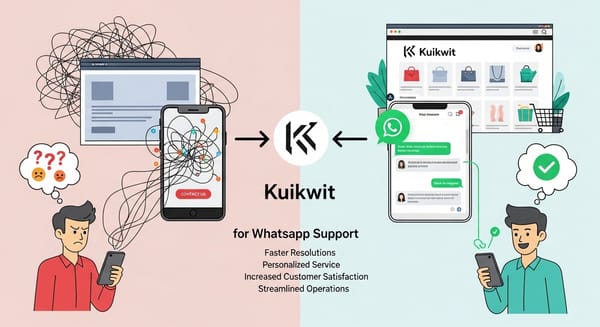
If you are running an e-commerce brand and your team deals with high volume every day, take a look at how online stores are using Kuikwit for WhatsApp support. A lot of the attitude improvements come from simply removing the friction that was making agents sound rushed and impersonal in the first place.
And look — if your sales process runs through messaging, which most do now, the link between agent attitude and actual revenue is direct. A confident, warm agent with the right context closes more than a stressed one guessing their way through a conversation. That is not theory. That is just how it works.
For teams using the WhatsApp Business API, Kuikwit takes care of the operational headache so your people can focus on the only thing that really matters — talking to customers like actual human beings.
The Money Side, Since Someone Will Ask
Alright, for the skeptics in the room who think “be nice to customers” sounds like something from a kindergarten poster. Here is the business case in plain terms.
Customers who feel respected come back. That is not a guess. You can literally track it. The ones who had a great support experience buy again at higher rates than people who never needed support at all. Think about that for a second. A problem, handled well, makes someone MORE loyal than if the problem never happened.
Happy customers talk about you. To friends. On social media. In reviews. You know how expensive it is to get that kind of word-of-mouth through paid advertising? You cannot buy it. But one agent who goes slightly above expectations on a random Wednesday afternoon can generate it for free.
And on the team side — agents who feel supported and positive burn out slower. That means lower turnover. Lower hiring costs. Less time training new people. The math works out even if you only care about spreadsheets and not feelings.
One Last Thing
You can have the best product on the market. The most beautiful website. Prices that undercut everyone. But if your customer service feels cold, robotic, or indifferent, you are leaving money and loyalty on the table every single day. People buy from brands they trust. They trust brands that treat them well. And “treating them well” comes down to individual conversations between your team and your customers.
Attitude is not a soft skill you mention in a job listing and then never think about again. It is the engine behind retention, referrals, and repeat revenue. It is the thing that turns a one-time buyer into someone who tells their friends about you. And the beautiful part? It does not require a bigger budget. It requires intention, the right environment, and tools that get out of your team’s way.
Every conversation your team has today is a chance to make somebody’s experience a little better than they expected.
That is not just customer service. That is how you build something people actually care about.