Why Speed Is Critical in Customer Communication-2026


Faster customer response time has essentially become a baseline feature of a good customer experience nowadays. Customers nowadays expect speedy and clear answers not only via emails but also through online chats, social media, and messaging apps. Trust is one of the first things that prompt businesses with a swift response to get trapped in the churn of the competitor if they are well-behaved and solid at their conversions, while those that don’t respond lose customers unnoticed and quietly. However, increased response speed is not about simply giving hasty answers but rather about having customer conversations that are smoother, more reliable, and more human.
What is customer response time?
Customer response time is the time between the customer’s first contact and the business’s reply. The contact can be made via email, live chat, social media, SMS, or messaging apps.
Is faster customer response time worth it?
This is one area where faster really is better. Customers are happier, and the whole business operation runs more smoothly when the speed of handling requests increases. It was also demonstrated that improving typing speed and accuracy in live chat acts as both an upsell driver and a direct revenue-generating lever.
How does faster response time work in practice?
Faster response time emerges from well-documented procedures, one unified communication platform, helpful automated responses, and a team that is well-trained and keen to timely acknowledge the customers’ needs and give them meaningful and helpful replies.
How Faster Customer Response Time Works
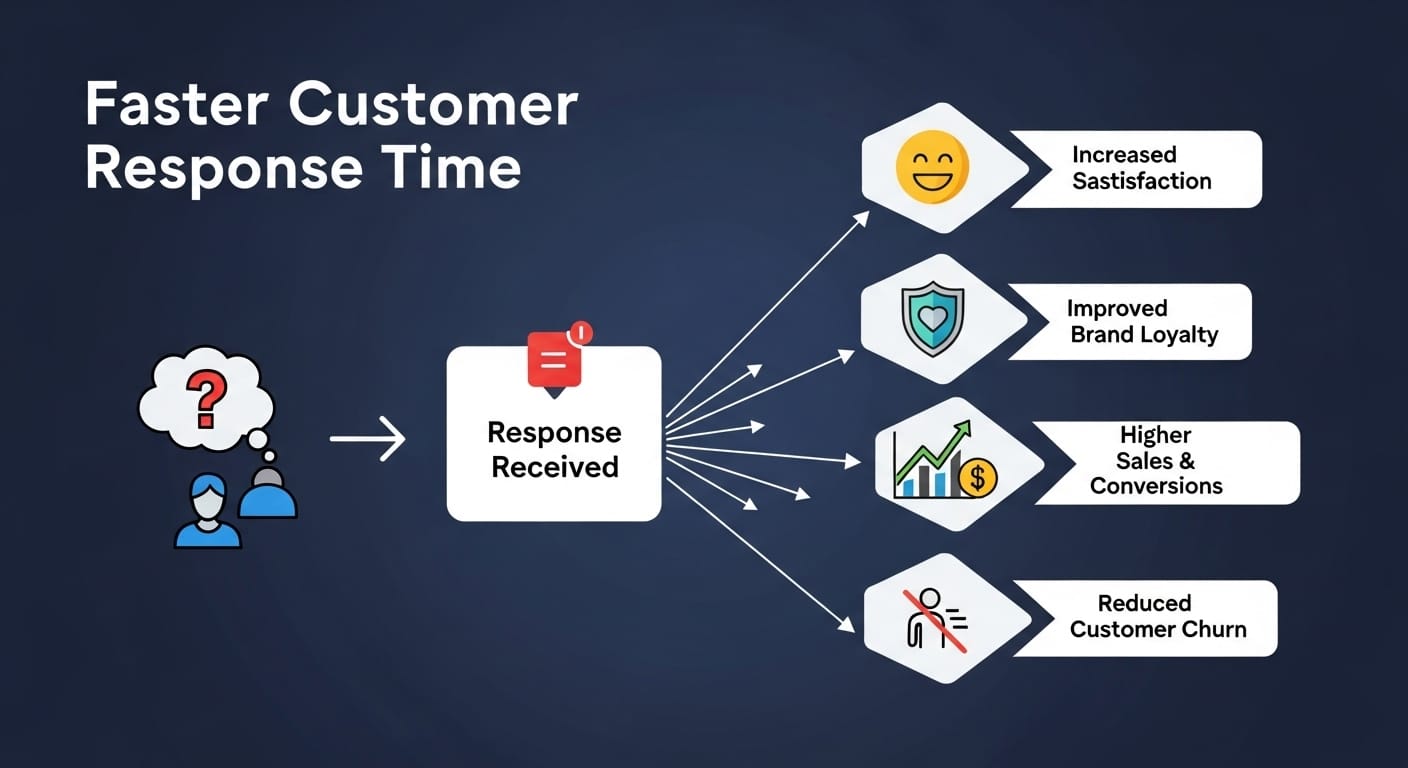
Faster customer response time is not an accident; it is the culmination of the alignment between the systems, the expectations, and the workflows.
At the heart of it, speed of the response rises when the business decides to remove the barriers from the communications. Nowadays, customers expect to be able to get in touch with the company in their preferred way: email, live chat, social media, SMS, and messaging apps. Of course, it is only natural that there will be a delay if these conversations are kept in separate systems. Such a situation results in messages being lost, misplaced, or simply being given a response at an unacceptably late time.
Streamlining Team Communication at Scale
Installing a shared messaging platform that hands over a single unified inbox to each member of the team for all incoming communication solves the issue of decentralization. New and old messages, together with customer information, are instantly available to each team member. This aligns closely with emerging messaging trends shaping team communication, where reducing fragmentation is key. Therefore, the internal misunderstanding among the employees is the root cause of time being spent unnecessarily scurrying from one platform to another.
Automations also have a very important role to play as a supporting system. By sending automated acknowledgments, the customers will be reassured that their message has been received. Routing rules allow inquiries to be instantly directed to the right team. Simple questions can be handled automatically, while more complex issues are escalated to human agents without delay.
Benefits of Faster Customer Responses
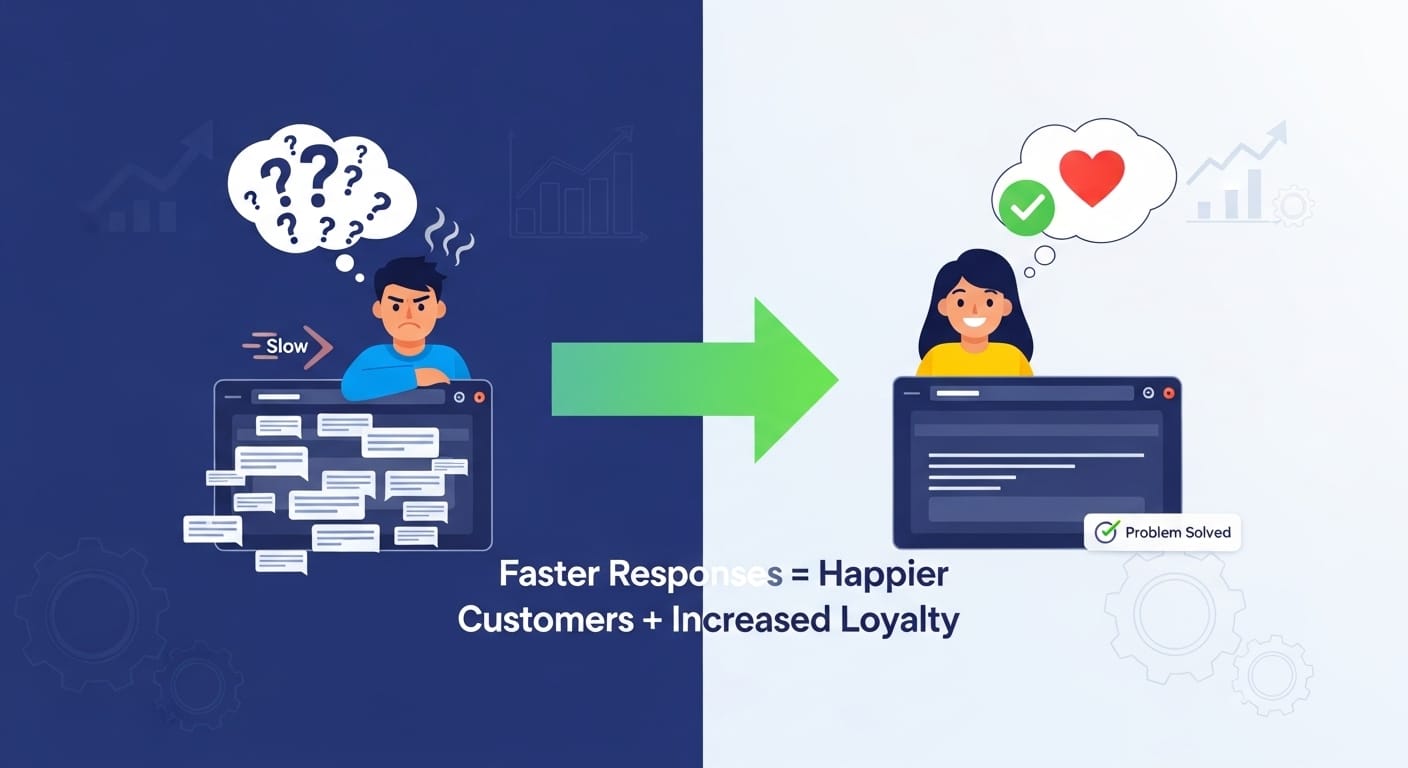
Builds Trust from the First Interaction
Fast talk means high respect. Getting a prompt response gives a customer the feeling that they have been recognized and their needs have been taken into account. Even a reply as brief as “We’re looking into this now” still manages to convey to the customer that their concern is being treated with seriousness.
Trust is what keeps the relationship going. Customers whose experience with the company is that it is never late in answering their queries become confident in the brand. This is how trust becomes a real brand differentiator in the course of time.
Improves Customer Satisfaction
Customer satisfaction is so much more than solving problems— it is also about the overall seamlessness of the customer journey. Customers become upset when they have to wait for a long time, no matter how fair the solution is in the end.
Replies that come swiftly reduce the feeling of uncertainty. Customers don’t get the impression that they have been left behind or ignored. This makes communication very easy, and the immediate consequence is better satisfaction scores and online reviews.
Reduces Customer Churn
There is rarely a singular cause that instigates a customer to leave. Rather, these decisions usually happen a bit at a time and as a result of a few disappointments such as a late reply, a message not being answered, or a follow-up that never arrived.
A faster response is one way to break the cycle of negativity. It keeps the line of communication open, helps resolve issues before they escalate into anger, and it is very encouraging when the customer can be reached and supported during difficult times. Retention, therefore, is becoming a natural consequence of customers feeling that their needs are being met and they are not left on their own.
Increases Sales and Conversions
In sales, when everything is perfect, one could say that it is timing, if one had to choose only one thing that matters. If a lead gets a response whilst he is still interested, then most probably he will convert, whereas if the same lead has to wait for hours or days then he may lose interest and not convert.
By replying to inquiries immediately, the query and the interest can proceed to the next phase without any breaks. The issues are solved before the customer has had the chance to feel suspicious. The second email will reach the customer whilst he is still deciding on the options, not after he has finalized the purchase.
Protects Brand Reputation
On their own, slow responses may not be making customers complain or write bad reviews, but can hardly be said to be contributing to the overall positivity of the brand perception. However, customers always notice and remember delays.
You can protect your brand reputation by quickly acknowledging your customers’ concern and transparently communicating with them, even if the issue is due to your faults. Many customers are willing to forgive if mistakes are recognized promptly and involved parties handled honestly.
Real-World Examples of Response Speed in Action
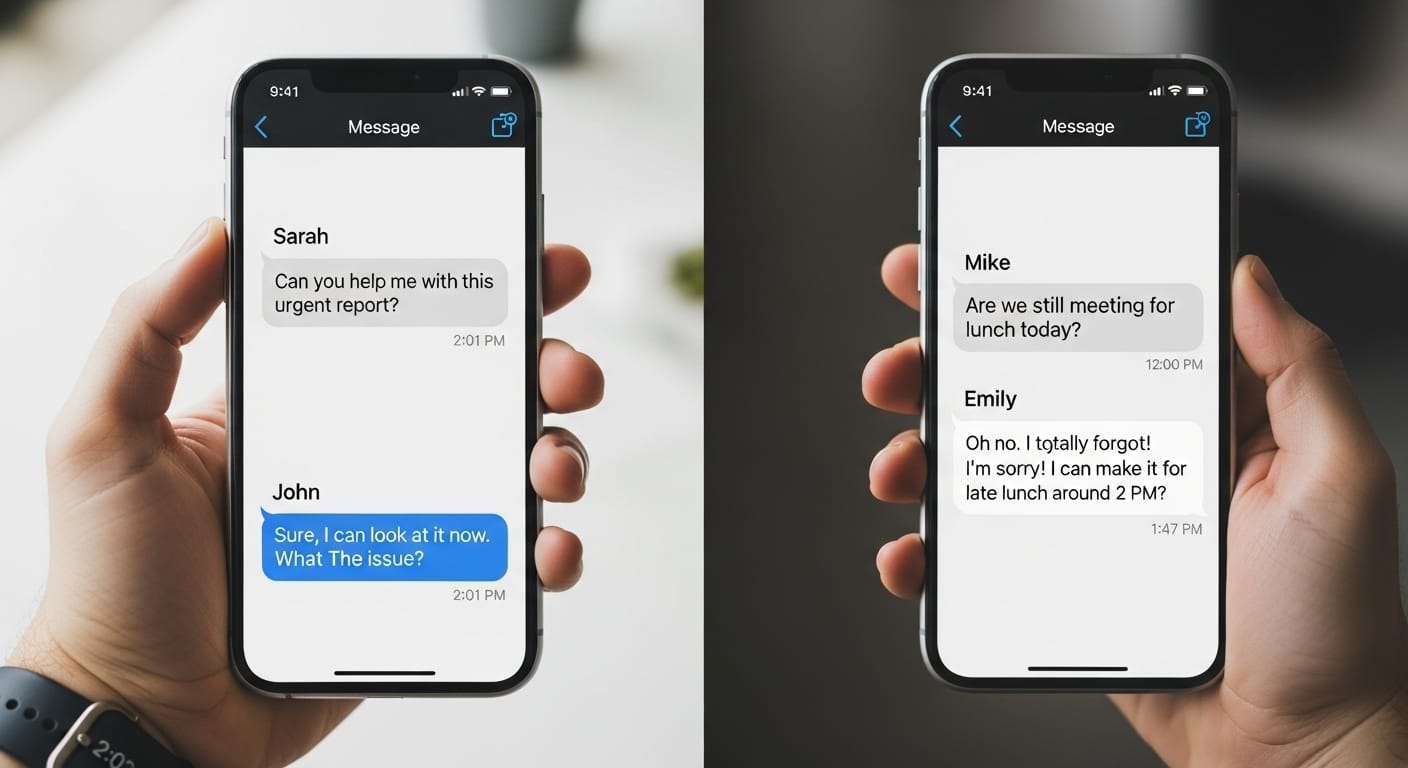
Startup vs Enterprise Support
Consider two companies that get the same customer email. A startup sends a reply after only ten minutes which is not only helpfully concise but also warm and friendly. On the other hand, a big organization sends back a generic template two days later.
There is a high chance that the customer will almost always trust the first company that answered him that is the one who replied quickest. Besides, it is the combination of speed and clarity that regardless of the size of the company firmly delivers the message of being competent and caring.
Customer Support Scenarios
A customer contacts her service provider to complain about a mistake in the bill. She gets immediate feedback in the form of an email stating that her request is being processed. Thus, although it might take a while before the whole issue is resolved, the open communication will prevent any anger or impatience.
On the other hand, the silence for a whole day would only make the customer uneasy and doubtful, hence, she would lose her trust and consider the issue as worse.
Sales Inquiries
Potential clients often ask for prices or stock availability. The next discussion or transaction almost always follows the initial quick reply. However, a lack of immediate response causes a decrease in interest or the competitors coming into play.
In many negotiations, it is the person who answers first who ends up winning the deal.
Common Mistakes That Slow Customer Response Time
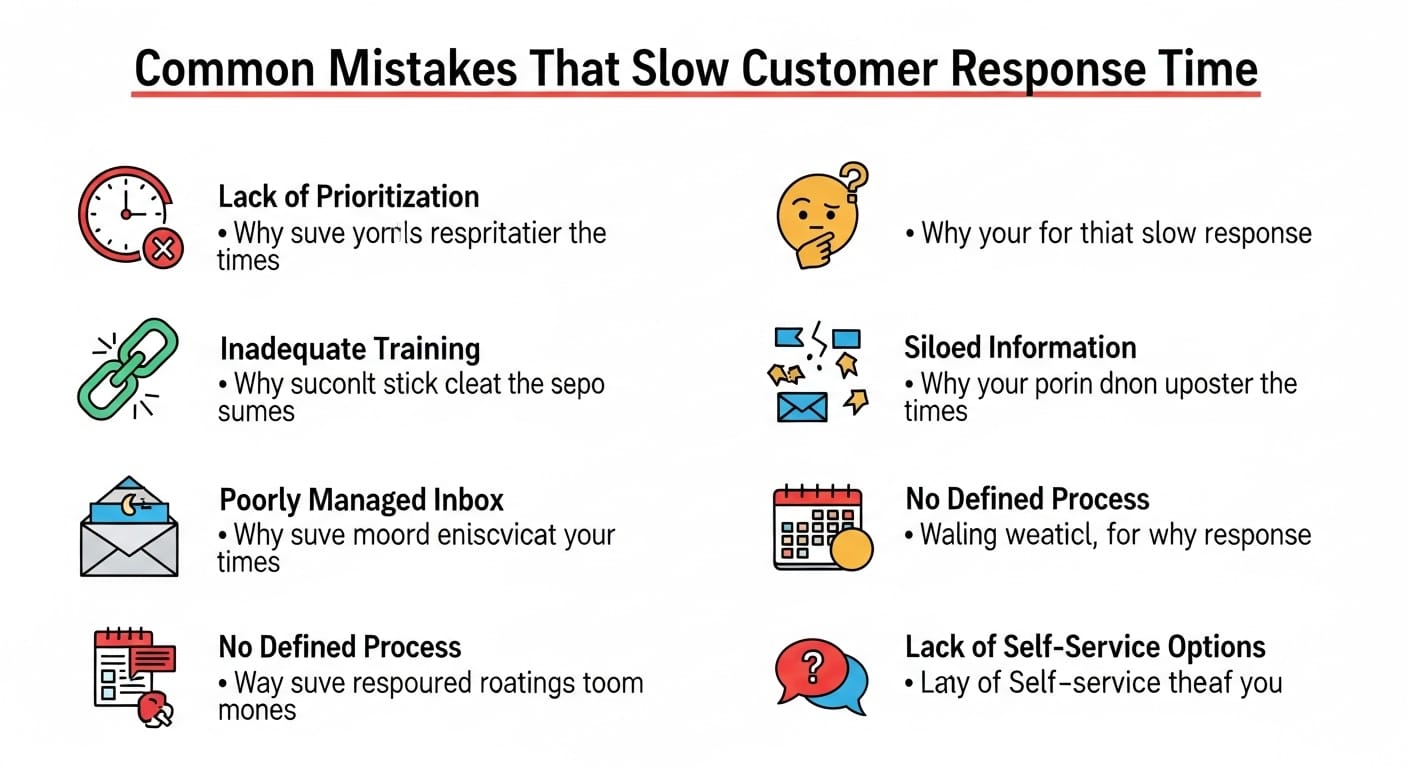
Relying on Disconnected Tools
Splitting the communication channels between email, chat, social media, and SMS, only resulting in the team losing track of some messages is a very common mistake. Changing the interface from one tool to another is not only time-consuming but also results in one’s getting mixed up or making mistakes.
Overusing Automation
Excessive use of automation leads to the communication taking on an impersonal, mechanical, and sterile character. Quite quickly, customers get the feeling that the responses they receive from the company are impersonal and irrelevant. The role of automation is to assist humans rather than to be their substitute.
No Clear Ownership
Great delays will inevitably encumber the response time if nobody is holding the messages coming in accountable. Specifying the owners is a sure way to get the messages quickly.
Treating Speed as Optional
Still, some companies consider the response times as merely an extra feature. In truth, it’s an expectation that’s baked right in. If it’s handled as an option, then it’s the customers’ relationships that end up put on the line.
Not Measuring Performance
Teams can’t find the reason for any delay or fix the problems in their working methods if response time isn’t tracked. Just a random guess results in shaky and inconsistent performance.
Faster Response vs Slower Response: A Direct Comparison
| Fast Customer Response | Slow Customer Response |
|---|---|
| Regains customer trust quickly | Makes customers suspicious and frustrated |
| Gives customers reasons for sticking around | Customers leave after being neglected |
| Enhances brand reputation | Brand loses credibility |
| Leads to more conversions | Warm leads leave and sales get lost |
| Lowers stress levels of the team | Creates a backlog routing work to burnout |
How to Improve Customer Response Time Effectively
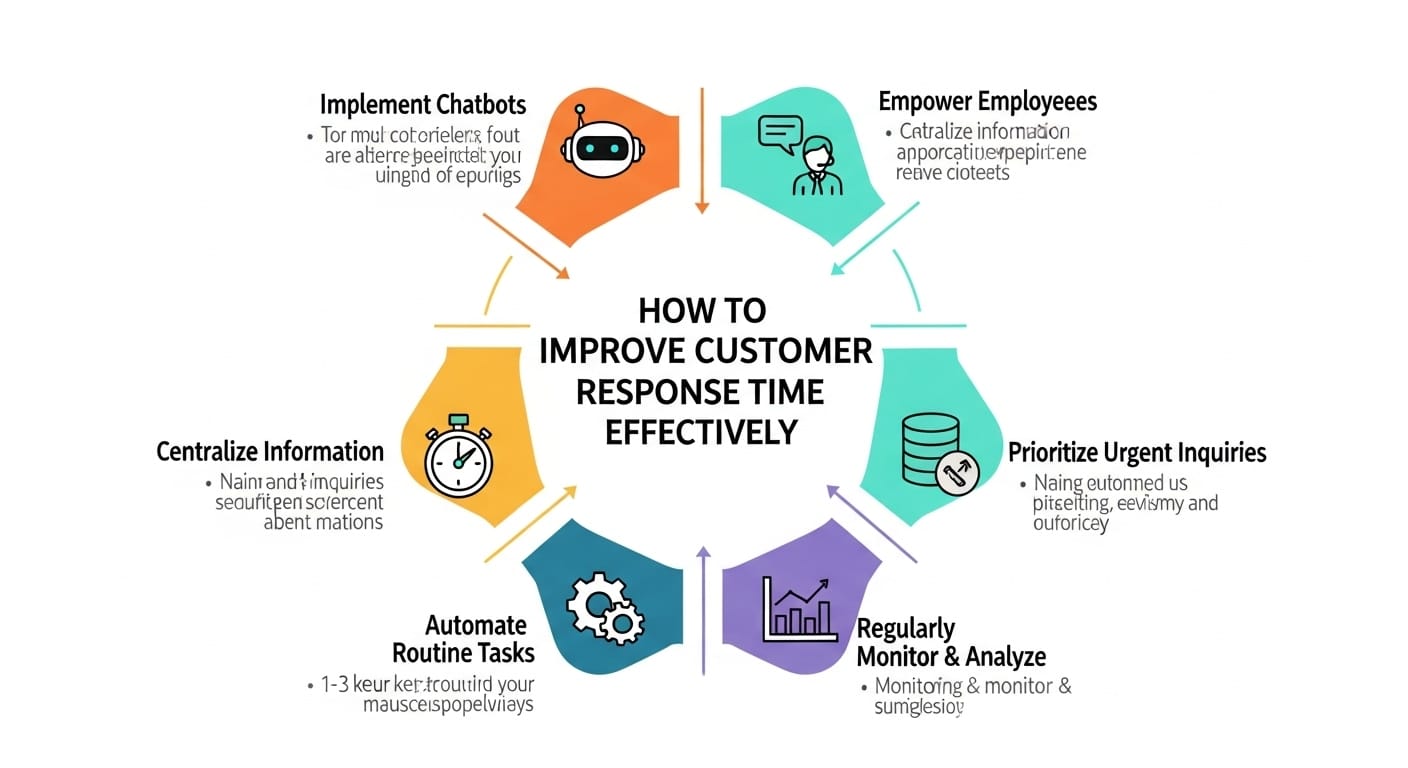
One does not have to have a big team or spectacularly high expectations to achieve increased response speed. What is required is concentration.
The place to begin is by figuring out the points of contact. Then combine those channels. Decide on the exact target response time for each channel according to what the customers expect. Implement automation to deal with acknowledgments and routing. Finally, educate your team to respond clearly, compassionately, and steadily.
Even the tiniest upgrades—like instant acknowledgments or better ownership—can have a momentous influence on the way customers feel.
The Role of Omnichannel Messaging
Omnichannel messaging is a means of linking all the different customer contacts into a single uninterrupted stream of communication. Customers are allowed to switch from email to chat to social media without losing the thread of conversation. The agents need to see only one view of the entire interaction history.
Thanks to this feature, customers do not feel like they are being interviewed again and again, therefore reducing the chances of repetition, speeding up the replying time, and increasing satisfaction. Customers are more likely to feel “heard” than “re-set” with every new interaction.
Automation Should Support Humans, Not Replace Them
When the tasks are repetitive and predictable, then automation is a good solution. Take for example, confirming the receipt of a letter, answering the frequently asked questions, or routing the messages properly.
Human agents are the ones dealing with subtleties, empathy, and the process of finding solutions. When automation steps in to take over the tedious tasks, humans end up working more efficiently and readily.
The ultimate aim is faster human connection rather than robotic efficiency.
Faster Responses Help Internal Teams Too

What is being talked about here is the question of response speed, only that instead of the customer being the prime concern, it is the employees that have to be considered.
A backlog is the cause of stress while missed messages may cause anxiety. Confusion, therefore, will eventually lead to burnout.
With clear dashboards, visible priorities, and manageable workloads, members of the team are more able to cope and feel that they have control over the situation. And when a team can keep up with the work, it is the morale that benefits. High morale brings about a happy customer experience, and thus the positive loop gets closed.
How Response Time Expectations Vary by Channel
- Live chat and messaging apps: Immediate response
- Social media: Can wait for resolution but fast acknowledgment is always required
- Email: More time may be given but not as much as in the past; still must be faster
Recognizing these expectations enables companies to set achievable goals and to avoid disappointing customers unintentionally.
Measuring and Tracking Customer Response Time
In order to bring about an improvement in response time, it first has to be measured. Some of the key performance indicators are:
- First response time
- Average response time
- Resolution time
Observing these same metrics across various channels will enable you to spot the problem point and deciding on the measures to implement. Facts and figures thus replace opinions and the teams’ energy is directed to the area where it makes most difference.
Faster Customer Response Time and Customer Retention
Retention is considerably less expensive compared to acquisition. Faster responses make it easier for retention to take place.
Customers who feel that they are cared for, are going to be around for longer. They will get more from their purchases and vice versa. Furthermore, they are more likely to refer to others. Without noise, speed of response will naturally be the driver of growth over time.
Full FAQ Section (People Also Ask)
What is customer response time?
Customer response time expresses the length of time that passes between the customer contacting a company through any communication channel and the company in turn replies to the customers.
What is considered a good customer response time?
The answer depends on the communication channel. A live chat usually necessitates that the response should be within a few minutes while email might tolerate a few hours. In general, the quicker the response is, the better the result will be.
Why do customers expect faster responses today?
The real-time communication tools have drastically changed the way our expectations are set. Customers have become accustomed to getting an immediate response and they bring that same expectation to the interactions with the businesses.
How does omnichannel messaging improve response time?
Centralizing the communication, preserving the context of the conversation, and lessening the need of changing tools—such features empowering the team to come out with speedy and more accurate replies.
Can automation improve customer response rates?
Yes, by the proper use of it. Automation takes care of acknowledgments and the simple questions freeing the humans up for the complex ones.
Does faster response time really reduce churn?
Definitely. If one were to talk about a number of customers leaving the company, then the cause was usually that problem has not been communicated well and not big issue itself. Loud protests are stopped by fast communication.
Is speed more important than quality in customer support?
They complement each other nicely. Being rapid in acknowledging a complaint and later on giving it a well-thought-out answer more often than not scores higher than remaining silent while working on a perfect reply.
How can small businesses improve response time?
Centralizing messages, setting clear priorities, using automation smartly, and placing the focus on the key channels are the ways small businesses can enhance their response time.
How does response time affect sales?
Keeping the cycle of buying-interest active by quickly replying to the buyers results largely in the increase of the conversion rate.
What tools help improve customer response time?
Centralized messaging solutions, the deployment of automation, and analytics dashboards are some of the tools that allow companies to get responses out faster without necessarily having to add more staff.
Final Thoughts
Nowadays, faster customer response time is not even a question. It has become one of the major drivers of customer experience, trust, retention, and revenue, not to mention across the board, all industries.
When the right systems are in place, a business is talkative on the subject of being speedy via email, chat, SMS, and social media while not forgetting to leave plenty of room for human interaction. Thus speed will change its role and become your strength and not your burden.
The question no longer is whether response time is significant. Rather, it’s about where you’ll set out to enhance it.